Rustic Pottery: Woodfiring

Copyright 2005 St. John's Pottery

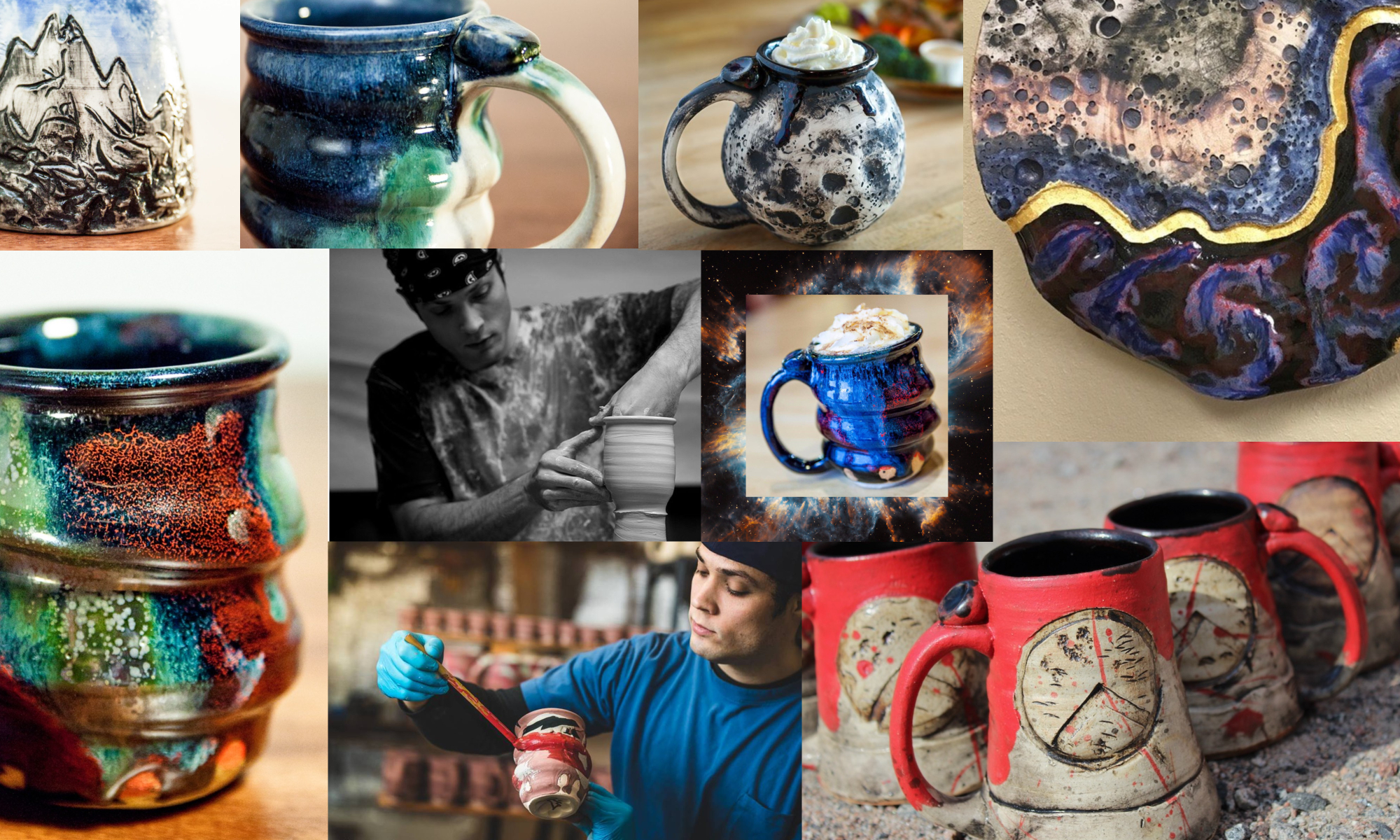
My interest in something I like to call rustic pottery began in high school, after my first visit to the St. John’s Pottery.  I was impressed by the idea of harvesting pottery materials directly from nature, but even more blown away by the colors and surfaces achieved by Richard Bresnahan and his apprentices.  I bought the book Body of Clay, Soul of Fire and it sat across from my pottery wheel for the rest of my senior year.  Richard’s pottery was glazed naturally by wood ashes and flame that floated through the 87 foot long kiln, painting the pottery over the course of a 10 day wood firing.  I tried to replicate his glazes and surfaces in our small electric kiln at Xavier High School and this made for some bright colors, but I was thirsty for the juicy wood fired surfaces.

I finally got to experience the use of natural materials during my freshman and sophomore years at CSB/SJU, interning at JD Jorgenson Pottery.  JD, a former apprentice at the St. John’s Pottery, taught me how to use natural clays in both pottery and kiln building.  We built a 3 chamber wood-kiln over 30 feet long and fired thousands of pots in over a dozen firings.  JD’s kiln produced a huge variety of wood-fired surfaces, so I busted out as many little cups as I could to put them in every nook and cranny of the kiln.  Most pottery was loaded as just raw clay, and each firing taught me more about how flame and wood ashes paint the clay surface.


Even my advisor and ceramics professor, Sam Johnson, was interested in wood firing during his 4 years of my undergrad that he spent firing mostly in gas kilns.  Sam built a wood kiln at the University of Minnesota Morris, which fired he his work in occasionally; however, his gas fired pottery (he called it his “whiteware”) was meant to be shown with his dark, wood fired surfaces. Sam’s process really motivated my interest in gas firing, and his critiques of my glazeware helped me find parallels with my wood fired work.


The wood fired surface continued to influence my pottery for the remainder of college and shows up in my current work.  Even with glazed pottery that’s fired in an electric or gas kiln, I look for glazes with rustic colors, surface qualities, and variation that occurs during the firing.  Copper Red glazes provide deep, intense color that reminded me of the bright colors and asymmetrical patterns that Richard achieves on his pottery.  The Nuka glaze utilizes local wood ash as the main glaze ingredient, and the ashes make for juicy surfaces with rustic tones.  I brush iron onto the glaze, which drips during the firing as gold and brown streaks as it reacts with the wood ashes at 2300 degrees F.


I’m still amazed how elemental pottery can be: water, clay, wood, and fire are used to make tableware for everyday use, and the earthen materials create a rustic, earthen aesthetic.  Wood firing taught me to give up some control and let the process speak.  The pottery you eat and drink from at the Local Blend is fired in a gas or electric kiln, but it’s influence by the wood fired process and surface.

The Ghost in the Mirror

Guest Posting by Staz – Matt Stasica

Jimi Hendrix, one of the most legendary guitarist and revolutionary rock musician,  also had a stick in the philosopher bonfire.

Jimi and his guitar is on fire!

A transcending quote by the legend goes as follows, “I used to live in a room full of mirrors; all I could see was me. I take my spirit and I crash my mirrors, now the whole world is here for me to see.” In our room full of mirrors and billboard postered walls, can we ever see the truth?  Can we go beyond Target plastic ware and Wally World knock-off ceramics (obviously made by the cold, steely machinery).  Grab your plastic tuberware sandwich containers, rubber molded cups, imitation ceramic coffee mugz and hurl them into the mirrors, bad luck will not follow, the witch Petronilla de Meath gave me her word.

On another note: Live music is a transcendental experience not only for the listener or audience, but also for the artists performing.  Even though set lists are composed of songs found on the album, leaks of human error spill out – every once and a while – filling into the ear drums of the crowd.  However, these errors don’t lead listeners to delirious convulsions and contortions, but rather they melt into an art of improvisation.  Temporally, these “out of cue” moments become stored in the mind and bore more meaning and mass into the music, the artist, and the band; rather than, per say, a flawless perfected show that exactly replicates every down stroke, note, rhythm, and harmony. (man, doesn’t that sound like a machine).  Look at some handmade ceramics and taste the difference.

Pai Mei

Every artist recognizes the difference between mistakes and “works of trash.”  Most will smell different than a Jackson Pollock or Max Ernst piece of work; for the most part they would smell like an old dirty pair of shoes that have had some Zombie foot spending its time decomposing and sitting idle and motionless…you gotta trust me, even a former president saw the Zombies as a real threat.  But to learn from these “works of trash” and move forward, can provide a lesson that Pai Mei would generously dish out to any of his disciples.  There is no free lunch, and the waves of T.V. infomercials will tell you differently; but, then again, who would believe a testimony made by sweat-scaled lizard waiting to steal your eggs of the future.

Mistakes are not on anyone’s menu, but they happen to be served sometimes with a large glass of iron stained well-water.  Cherrico Pottery has had it’s fare share of catastrophes but cracked platters and bubbly pots are just a couple…hundred fallen soldiers along life’s warpath.  Too much energy in the wrong direction and you’ll be swimming with the fishes, or on clouds of Surrealism, as the forever 27 crew found out all too soon.


The universe might be named after a candy bar, but does it taste just as its advertised?  All the nicks, dings, dents, chipped out pieces left by the past are a reminder of “that one time…”  The Local Blend coffee shop is an outlet for Cherrico Pottery.  Serving its delicatessen with a side of ceramic slung pottery.  By natural events, handmade coffeeware is dinged up daily!  Even though you might stumble across a chip or 2 on your mug, don’t fear the flaws.  Like scars on your skin, these unavoidable tattoos reflect the life-history of the mug and it’s journey through the Blend.

Photo by Jenny Birkhofer

Don’t plaster up the hole in the hallway wall – the result of playing catch with a softball inside.  That faded and shabby concert shirt you have from the 1980 Van Halen tour, “World Invasion: Party Tll’ You Die,” should be framed, or just keep on rocking it on Casual Friday.  You spend your life developing flaws in your character, why fix em’?


Sculpture, Pottery and the Nautilus

Guest Posting by Matt Stasica

Art has looked nature in the eye, held out fist fulls of gold, in order to bargain for nature’s physchotrophic prowess and phenomena. Just enough gold has been traded in order to cast lost secrets of the elements of design into the light. Simple organic replication sets a flame to any piece of art especially when it is held steadily in a crazed art enthusiasts gaze, as seen in Joel’s 1st place piece in the current exhibition at the Paramount Arts Center, Light/Shadows:

"Don Reitz, Ernst Haeckel" Wood Fired Stoneware, 28" x 16"

Titled after 2 artists that inspired the piece, Joel spun the wheel and formed organic shapes before assembling this stacked vessel form, in a similar fashion as Don Reitz- an American Master of Abstract Expressionism.  View his genius interpretations of teapots, in this 26 inch tall “Teastack” at the Lacoste Gallery, in Massachusetts:

Don Reitz, "Teastack" Wood Fired Stoneware, 26" x 14" x 13"

Reitz succumbs to the Abstract Expressionist process, skewing pottery forms and ending at a new beginning.  Joel’s sculptural vessel is more removed from vessel based Abstract Expressionism due to it’s biological sense of order.  It’s counterpart was also accepted to this show, entitled “Stinkhorn” because of it’s reference to the wild mushrooms that seem to grow out of another realm.


With biological abstractions that maintain a sense of stability, both of Joel’s sculptures beckon similarities to the nautilus shell.  The nautilus, a thin spiral shell-bound organism, can be found replicated in countless pieces of art, culture, history and science. Illustrations of Ernst Haeckel embody it’s allure.

http://www.johnchiappone.com/hum_int.html

In some forms, the nautilus may be a mind bending illusion that petrifies peoples minds to a trance state; to others, a sign of order and balance.  Its shell is a medallion to biotic art and organic designs. Its meaning – perfection, or some call it “the western dream.” A steady stare into the shells mesmerizing spiral can juice out phsychotrophic alterations. What does the spiral mean? Is it a path, a line, going up and out or down and in? Are we in the fade with lock jaw monsters – nipping at our gullets – broadcasting from billboards and T.V. infomercials. Where is truth in such a mirage of design?


The meaning to the nautilus is possibly a far out conclusion- sort of like the meaning to/of life (which happens to be the number 42. By the way the number 42 is a unique number having varying properties such as being a primary pseudo-perfect number, or the angle (measured in decimal degrees) of a rainbow.) Maybe finding the meaning to the the nautilus is the backwards approach to the answer. Artists see beyond the square and see a cube, Ceramicists see beyond a cube and see its history in time.  Similarly, artist Alex Grey makes mind bending, cerebral art that links a viewer to another dimension, while connecting with so many historical landmarks.

On the other hand, ceramic mammoth monolithic vessels carry a shape, physical texture, and an awareness to function over the centuries.

Why the nautilus? Why not. The thing about placing a design is that its jigsaw must fit into the universe of things. Looking at Cherrico’s placement of the nautilus design you can tell that its placement was premeditated and ordered to fit – or – the free-flowing rock/funk enthusiast has just let things go to the wind:


If you were to ask a Nautilus, “what is the meaning of your shell?” it may vividly responded that, “its design is perfect for the function.” Ceramics and the nautilus are a marriage of earth and life. If one were to divorce the other, well… that’s for another episode.

Glaze testing at JD Jorgenson Pottery

I’ve spent the past week and a half firing the small gas kiln at JD Jorgenson Pottery, in order to accomplish a couple things with the Nuka glaze.  At the St. Ben’s ceramics studio, I fired the glaze to cone 12 flat, almost cone 13 (about 2410 degrees F).  At these temperatures, it takes a long time and huge amount of energy to raise even a single degree.  It’s also harder on the kiln, shelves, and clay so it made a lot of sense to try and lower the temperature of the Nuka glaze before my new body of work.

The kiln at JD’s place was made from the shell of an old electric kiln that I salvaged from a high school in Sartell, MN.  They kept the electric box, so JD cut 2 small holes in the bottom of the soft brick to make burner ports.  Firing with gas instead of electricity will also let us test reduction firings very similarly to larger gas kilns.  These practice firings willhelp me for adapting to the Paramount Arts Center gas kiln, which I’m firing for the first time this Monday.  Fresh pots should be out by Art in Bayfront Park the next weekend in Duluth!

My first firing in this kiln was actually the second time JD fired it, and we got some really nice results.  The glaze fluxed out pretty well at cone 10 (that was our goal) but the bottom of the kiln only reached cone 9.  Also, even at cone 10 there were bubbles present in the glaze.  The Nuka contains wood ashes, which are high in alkali.  Something about the alkali cause bubbling in the glaze at high temperature, and the finished pottery had sharp holes and pits.  Problems like this are common when working with earthen materials, but the struggle is well worth the rustic tones and philosophies behind working from a waste stream system.

Here’s a few finished pots from the 2nd kiln firing, as well as some underfired ones.  The pieces on top are almost perfect, except for the bubbling where the glaze pooled.


JD and I learned a lot from these pots, but with a 22 hour firing into the night I wasted a lot of time and energy with the stalled out kiln.  The barometric pressure changes every night, and this generally makes it difficult to gain temperature.  Once the sun went down, we were at the mercy of the kiln to go at it’s own pace.  Night firing makes for some cool pictures, but a miserable next morning.

Right now I’m in the middle of the 3rd firing and the kiln is at cone 5 (almost 2200 degrees F).  Once it gets to cone 10, I plan to soak for at least 2 hours, so the bubbles will pop and the glaze will seal over.  At 6 hours in, we’re really close to peak temp and the soak period so things are looking good…definitely better than another firing into the weee hours of the morning uuhg…and hopefully the pots will turn out looking close to this good!


ROCK! Music that makes the wheel go round.

Rock is definitely my favorite type of music to throw to.  After a few hours of Red Hot Chili Peppers I just feel like I made more pottery than if I had been bobbing my head to Mr. Sunshine on my Shoulders, John Denver.  I do think mellow music can be great for detail work or anything tedious.  For example, when I mix and test new glazes I like some old Coldplay, like High Speed.  Here’s an image from a bunch of testing that I did during my senior thesis in Spring, 2010 on the Nuka glaze:

I’ve never been a fan of tedious work that takes a lot of concentration.  I’ve made tedious work even since freshman year in college, but I like to work fast.  I made this one for a cardboard project in our Intro to 3D Design class.  It was partly the result of a whole lot of Smashing Pumpkins.


In Spring 2009, I went to Northern Arizona University to see 6 artists at a 2 day workshop. Don Reitz really stood out in my head because of his style of working and because his sculptures seemed really fresh.  His process reminded me of drippy paintings by Jackson Pollock.  This is my favorite way to make artwork: fast and direct.  With Abstract Expressionism, you go with the flow and surrender to the process.

For me, the Red Hot Chili Peppers embody this artwork in their music.  Anthony Kiedis belts out catchy vocals and lyrics hidden in random sentences that would be grammatical nightmares.   Flea’s bass lines have a huge presence in every song, and they meshed perfectly with John Frusciante’s melodies and Chad Smith’s loud, fast beats- good luck finding a drummer that hits his drums harder. The band writes each song from jamming- just rockin out together and letting the music flow.  With Frusciante now pursuing his solo career, he trained in little Josh Klinghoffer to live up to his legacy.  After releasing their new single I’d agree with Rolling Stone that their “juicy funk-pop groove” isn’t going anywhere.  I have a feeling I’ll still be throwing pottery and sculpture to the Chili Peppers for decades to come, hopefully with the same energy embodied by their music, Abstract Expressionists and my Mindscape sculptures.

Take it from Dave Grohl, drummer of Them Crooked Vultures and lead singer/guitarist of Foo Fighers.  He rocks with the best of them and knows there are few things in this world that can get you going like a heavy rock song.  Well, maybe a FRESH POT!!